
Importance of lubricants recycling
Re‑refining waste motor and industrial oils reduces the demand for oil extraction, helps conserve natural resources, and minimizes the risk of soil and water pollution.
At «Caspian Lubricants Recycling» LLC, we are committed to ecological sustainability and support for environmental protection.
Importance of lubricants recycling
Re‑refining waste motor and industrial oils reduces the demand for oil extraction, helps conserve natural resources, and minimizes the risk of soil and water pollution.
At «Caspian Lubricants Recycling» LLC, we are committed to ecological sustainability and support for environmental protection.
A new stage of sustainable economy
Every ton of base oil produced from crude oil requires more than six tons of raw material, eight specialized processes, and consumes high amounts of energy, releasing hundreds of tons of CO₂ into the atmosphere.
Producing 1 ton of base oil through waste-free eco-friendly recycling process of «Caspian Lubricants Recycling» results in:
usage
consumption
emissions
A new stage of sustainable economy
Every ton of base oil produced from crude oil requires more than six tons of raw material, eight specialized processes, and consumes high amounts of energy, releasing hundreds of tons of CO₂ into the atmosphere.
Producing 1 ton of base oil through waste-free eco-friendly recycling process of «Caspian Lubricants Recycling» results in:
Raw material handling and analysis
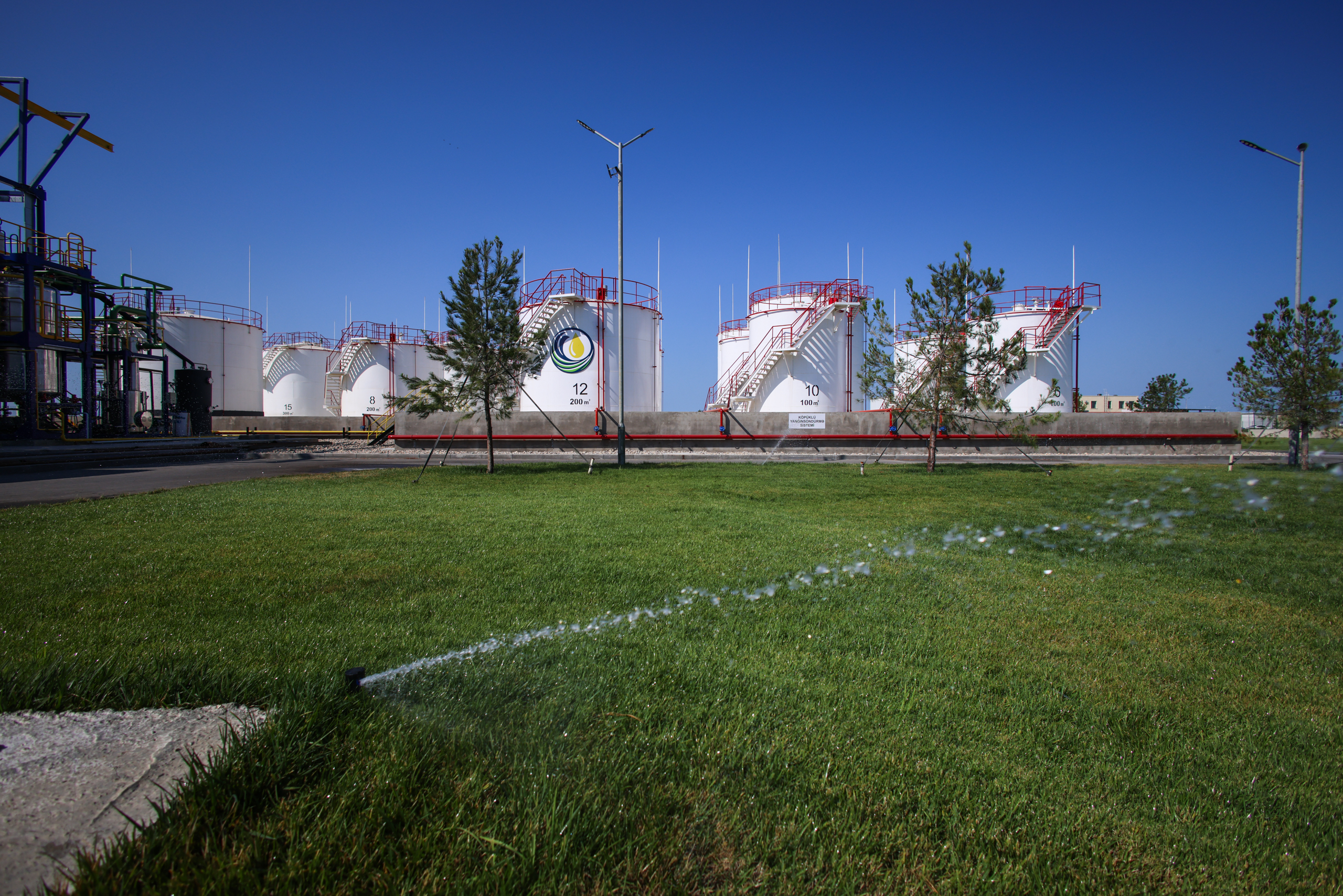
«Caspian Lubricants Recycling» LLC accepts waste motor, industrial oils and other lubricants and stores them in 16 dedicated storage tanks with a total capacity of 5 400 m³.
Storage tanks are equipped with programmable logic controllers, foam-based fire suppression systems, and level sensors to ensure the safe storage and management of raw materials and finished products.
Before undergoing re-refining process, the raw material is analysed in our laboratory using modern measuring equipment, and the oil’s main technical parameters – density, viscosity, flash point and pour point are determined.
The obtained results are used to assess the quality and composition of the raw material, and at the same time helps determine its suitability for the recycling process in advance and enable more precise system control.
Our company implements an advanced three-stage waste oil recycling process that is fully automated, has a production rate of 3000 l/h (24 000 MTA), is equipped with PLC and SCADA systems, and fully complies with modern international standards.
During the re-refining, accumulated contaminants, including combustion byproducts, oxidation residues, and remnants of degraded additives are removed, thus restoring the oil to its original state, creating chemically and physically indistinguishable base oil.
Raw material handling and analysis
«Caspian Lubricants Recycling» LLC accepts waste motor, industrial oils and other lubricants and stores them in 16 dedicated storage tanks with a total capacity of 5 400 m³.
Storage tanks are equipped with programmable logic controllers, foam-based fire suppression systems, and level sensors to ensure the safe storage and management of raw materials and finished products.
Before undergoing re-refining process, the raw material is analysed in our laboratory using modern measuring equipment, and the oil’s main technical parameters – density, viscosity, flash point and pour point are determined.
The obtained results are used to assess the quality and composition of the raw material, and at the same time helps determine its suitability for the recycling process in advance and enable more precise system control.
Our company implements an advanced three-stage waste oil recycling process that is fully automated, has a production rate of 3000 l/h (24 000 MTA), is equipped with PLC and SCADA systems, and fully complies with modern international standards.
During the re-refining, accumulated contaminants, including combustion byproducts, oxidation residues, and remnants of degraded additives are removed, thus restoring the oil to its original state, creating chemically and physically indistinguishable base oil.
Atmospheric and vacuum distillation
During the first stage, dehydrated used oil undergoes atmospheric distillation to remove dissolved hydrocarbons of diesel and gasoline fuels.
This process is entirely waste-free: the separated water is repurposed as technical cooling water, while the recovered diesel fractions are prepared for further use. That way we ensure the circular use of resources, minimize environmental impact, and contribute to the principles of sustainable production.
At the second stage, the purified oil is then subjected to vacuum distillation at high temperatures. Thin-film evaporators enable the precise separation of oil distillates, while components not required for further production are removed.
This stage is performed under deep vacuum conditions at temperatures exceeding 300°C. To ensure environmentally safe emissions, gases released from the vacuum system undergo a two-stage purification process – with an alkaline scrubber and a thermal oxidizer.
Atmospheric and vacuum distillation
During the first stage, dehydrated used oil undergoes atmospheric distillation to remove dissolved hydrocarbons of diesel and gasoline fuels.
This process is entirely waste-free: the separated water is repurposed as technical cooling water, while the recovered diesel fractions are prepared for further use. That way we ensure the circular use of resources, minimize environmental impact, and contribute to the principles of sustainable production.
At the second stage, the purified oil is then subjected to vacuum distillation at high temperatures. Thin-film evaporators enable the precise separation of oil distillates, while components not required for further production are removed.
This stage is performed under deep vacuum conditions at temperatures exceeding 300°C. To ensure environmentally safe emissions, gases released from the vacuum system undergo a two-stage purification process – with an alkaline scrubber and a thermal oxidizer.
Regenerative adsorption
In the final stage, the distillate is purified at 80°C through regenerative adsorption, using special red corundum activated bauxite. This process removes components that affect the oil’s key properties, ensuring that the final re-refining stage brings the distillate to the required quality specifications for base oil.
Upon completion of the recycling process, the resulting base oil is analysed in our laboratory to verify its main parameters. At this stage, the density, viscosity, color, flash and pour point of base oil are determined, allowing the product’s quality to be checked and its compliance with international quality standards to be confirmed.
Regenerative adsorption
In the final stage, the distillate is purified at 80°C through regenerative adsorption, using special red corundum activated bauxite. This process removes components that affect the oil’s key properties, ensuring that the final re-refining stage brings the distillate to the required quality specifications for base oil.
Upon completion of the recycling process, the resulting base oil is analysed in our laboratory to verify its main parameters. At this stage, the density, viscosity, color, flash and pour point of base oil are determined, allowing the product’s quality to be checked and its compliance with international quality standards to be confirmed.
News and press
Let’s build an ecological future together!
Collaborate with us, we are always open to your proposals on waste oil recycling and other forms of partnerships.
If you have any complaints or suggestions, please send them to info@caspian-lubricants.com. We will be happy to assist you!
Let’s build an ecological future together!
Collaborate with us, we are always open to your proposals on waste oil recycling and other forms of partnerships.
If you have any complaints or suggestions, please send them to info@caspian-lubricants.com. We will be happy to assist you!